|
EuroEducation.net The European Education Directory |
||
|
|
| College of Europe |
|
| Address | Bruges campus:
Dijver 11,
BE-8000 Bruges,
BELGIUM Natolin (Warsaw) campus: ul. Nowoursynowska 84, Box 120, PL-02/797 Warszawa 78, POLAND | ||||||||||||
| Tel. No. | Bruges campus: +32-50-47.71.11 Natolin (Warsaw) campus: +48-22-545.94.01 | ||||||||||||
| Fax No. | Bruges campus: +32-50-47.71.10 Natolin (Warsaw) campus: +48-22-649.13.52 | ||||||||||||
| E-mail address |
info@coleurope.eu info.pl@coleurope.eu |
||||||||||||
| Course title |
- European General Economic Studies - European Economic Integration and Business Specialisation in: | ||||||||||||
| Type of course | Full-time | ||||||||||||
| Length of course | One Academic Year (66 ECTS) | ||||||||||||
| Date of commencement |
First semester: beginning of September to mid December Second semester: early January to late June | ||||||||||||
| Class size |
First semester: Students follow all together the respective departmental Compulsory Courses Second semester: Students follow Optional Courses and Seminars in classes of 20-25 students maximum. Tutorials are given throughout the Academic Year. | ||||||||||||
| Student accommodation | The College has a system of residences in the centre of the City of Bruges and on campus in Natolin (Warsaw). All students have individual rooms with private telephone and internet connections as well as a private bathroom and cleaning service. The halls of residences supply sheets, pillows, blankets, towels, duvets and cutlery. Washing machines are available in each residence. Microwave ovens and kettles are available in each residence. The size of the student rooms in each residence is around 15m˛. Each room has its own private bathroom. | ||||||||||||
| Fees |
2. Living costs at the College of Europe are pre-determined as students live in College residences (individual room is provided with private bathroom and cleaning service). These costs also include meals (breakfast-lunch-dinner) and internet and network access in each student private room. | ||||||||||||
| Student grants / Financial assistance | About 70% of students receive full or partial scholarships. | ||||||||||||
| Major recruiters of graduates of the College of Europe |
Alumni profiles: Services (e.g. Consultancies, Law Firms, Private Banks) 32% European Institutions (e.g. European Court of Justice, European Commission, European Parliament, European Investment Bank) 21% National Administration 17% Academia & Research 9% Primary and secondary sectors 7% International Organisations (e.g. World Bank) 5% Regional and Local Administration 2% Media/Culture 2% Federations, Foundations, Associations, NGOs 5% | ||||||||||||
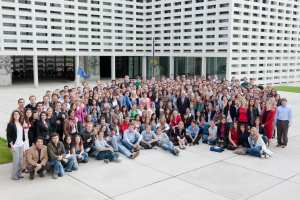
| Student profile | 400 postgraduate students / year coming from over 50 different countries
Ration Men: Women: 1:1 Average student age: 25 Age range: 22-35 | ||||||||||||
| Admission requirements | Admission requirements vary by postgraduate study programme. For current information regarding specific programme admission and language requirements, students should check the College of Europe website – www.coleurope.eu/admission. Typical admission requirements for applicants consist of: • A relevant university degree with good results. Admission to the College of Europe requires either a Bologna Master's degree, or a pre-Bologna equivalent degree, or a final university degree and at least 240 ECTS credits acquired in the course of one's university studies. Holders of a three-year Bachelor degree (180 ECTS) are also eligible provided they demonstrate strong qualification in relation to the academic programme for which they apply. Equivalence will be determined on the basis of objective criteria. • Good working knowledge in English and French (level dependent on the postgraduate study programme) • Strong interest in European Integration Application Process: • Online application • Supporting documents should be sent to the College and the respective national Selection Committee (if applicable) • No application fees Candidates must submit an online application for admission via the website of the College of Europe. A printed copy of the application and the supporting documents must be sent by postal mail to the national selection committee in the candidate’s country or region. A copy of the entire application must also be sent to the Admissions Office of the College of Europe. If there is no national selection committee in the candidate’s country or region, applications should be sent directly to the Admissions Office of the College of Europe. For more information on national selection committees please consult our website: www.coleurope.eu/committees. Selection Procedure: • Applications reviewed by National Selection Committees along with the College of Europe • Personal interviews | ||||||||||||
| Programme Directors |
European Interdisciplinary Studies Director of Studies: Professor Erwan LANNON (FR) Email: erwan.lannon@coleurope.eu EU International Relations and Diplomacy Studies Director of Studies: Professor Dieter MAHNCKE (DE) Email: dieter.mahncke@coleurope.eu European Economic Studies Director of Studies: Professor Jacques PELKMANS (NL) Email: jacques.pelkmans@coleurope.eu European Legal Studies (LLM) Director of Studies: Professor Inge GOVAERE (BE) Email: inge.govaere@coleurope.eu European Political and Administrative Studies Director of Studies: Professor Jörg MONAR (DE) Email: jorg.monar@coleurope.eu | ||||||||||||
| Contact for application | College of Europe Admissions Office Dijver 11, Bruges BE-8000 Bruges BELGIUM Tel.: +32-50-47.71.35 - Fax: +32-50-47.71.30 Director: Thierry Monforti Coordinator: Jenny Cortvriendt Secretaries: Belinda Deryckere, Valérie Willems E-mail address: info@coleurope.eu |
|
Postgraduate Programmes: Master of Arts in European Interdisciplinary Studies The internal and external dimensions of the European Union The programme invites students to view the process of European integration process beyond disciplinary boundaries and provides them with a comprehensive, well-rounded understanding of the European Union. Organised at the Natolin (Warsaw) campus of the College of Europe, this programme allows students to familiarise themselves with the political, social and economic challenges in Central and Eastern Europe and in the neighbouring countries of the enlarged European Union. Master of Arts in EU International Relations and Diplomacy Studies The programme provides specific knowledge of the European Union as an actor in the international environment, as well as skills in international negotiation and diplomacy. The programme thus aims at a comprehensive understanding of the EU’s external relations, bringing together an interdisciplinary analysis of its internal decision-making processes with developments in the broader context of international relations and diplomacy. Master of Arts in European Political and Administrative Studies The programme in Bruges provides students with a comprehensive understanding of the institutions and major policies of the European Union. It also examines the EU’s role at the international, national and regional levels. The programme aims in particular to prepare students for a career in European or national administrations, non-governmental organisations, or the private sector. Master of Arts in European Economic Studies - European General Economic Studies - European Economic Integration and Business Students in the Economics Department can choose between two programmes: European General Economic Studies & European Economic Integration and Business Studies. Through its professional dimension, the programmes prepare graduates to enter the private business sector, the European, international and national public sectors as well as the non-governmental sector, and may also serve as a stepping stone towards doctoral studies. Master in European Law (LL M) The programme establishes a balance between the economic and the constitutional aspects of European law, and emphasises both the increasing complexity of EU law and the context in which it is evolving. The academic programme and its professional dimension prepare graduates to enter international law firms, European institutions, international and national public sectors as well as the non-governmental and private sectors and may also serve as a stepping-stone towards an academic career. Specialisation in: European Law and Economic Analysis (ELEA) Interaction and interdependence between the disciplines of Economics and Law have become frequent and multi-faceted. Lawyers profit from a knowledge of the economic impact of legal rules in such areas as commercial or company law, and economists benefit from an understanding of the institutional legal framework underpinning different markets and a range of Community policies. Why Study at the College of Europe? “The academic quality and the variety of its postgraduate European study programmes are renowned worldwide. It attracts a highly qualified pan-European faculty and welcomes students from across the entire continent and further a field; it enjoys a truly European atmosphere on its Bruges and Natolin (Warsaw) campuses. As the careers of many of its alumni illustrate, the College degree opens up rewarding professional prospects in Europe and at the international level.” Rector Paul Demaret The academic programmes of Bruges and Natolin (Warsaw) provide students with a specialised grounding in the European dimension of their fields of study, as well as an in-depth understanding of Europe in all its complexity. By working together in an international community of students, academic assistants, faculty and staff members from all corners of the continent and beyond, students experience Europe first hand and benefit from a wide range of teaching methods and from challenging teamwork and negotiation exercises. The one year programme lasts from September until the end of June and is taught in English and French. To be awarded the degree, students must take oral and written examinations at the end of each semester, and submit a Master’s Thesis in English or French. The thesis gives students the opportunity to undertake individual research, conducted primarily in the second semester, under the supervision of a faculty member. The programmes are enriched by study trips to the European institutions and, for students at Natolin (Warsaw), also to neighbouring countries. Due to the College’s extensive network of contacts, students have the opportunity to meet and discuss with policy-makers, practitioners and representatives of the business community throughout their year at the College. Founded in 1949, the College of Europe was the world’s first and is one of the most reputed institutes of European postgraduate studies. It relies on a large worldwide network. Its programmes open up rewarding professional prospects in Europe and at the international level. The College of Europe is a unique university institute of European studies, located in two campuses: Bruges (Belgium) and Natolin (Warsaw, Poland). The College offers postgraduate education in an international environment, resulting in a truly linguistic and cultural diversity. A large number of full and partial scholarships are available, covering not only academic costs, but also a wide range of student services & facilities. The Careers Office works together with the Alumni Association to offer advice to students and young alumni on career planning. The College of Europe is characterised by its academic independence, its bilingualism, the diversity of its teaching staff and its multicultural environment, which together create a genuine European ‘microcosm’. Entry requirements and rigorous selection procedures ensure that students who are recruited are of the highest calibre. The student body, around 300 students in Bruges and 100 in Natolin, reflects a variety of cultures and a variety of personal experiences. Students come from over 50 countries, many speaking a number of languages. All have completed a university degree in a field appropriate for participation in the College’s postgraduate programme, and many already hold a postgraduate degree. Their average age is 25. Some of them are seconded from international organisations and national foreign services. The College’s residential life is a vital component of the student experience. By living together, students from across Europe and beyond work together and exchange views in both the academic and social environment. Through the intensity of this personal experience and interaction, students become familiar with the full cultural and social diversity of Europe and learn how to operate in an international environment. Next to the academic programmes the Development Office manages the College of Europe’s European and international projects and is in charge of the College’s activities in relation to its public and private partners. The Development Office organises training courses and offers project development and other professional services to universities, public bodies, private companies and non-governmental organisations. The Development Office provides a wide range of professional training courses, services for the EU institutions, tailor-made academic expertise and cooperation, projects developed in partnerships, workshops and a worldwide network of EU professionals, professors, alumni and partners. |
|
Request For Further Information |
|
EuroEducation Net |
admin@euroeducation.net CopyrightŠEuroEducation || Terms of Use | Disclaimer |